
The Cottages at the Cape

Margie and Phyllis wandered over to the outdoor concert area, Phyllis exchanging greetings and hugs with a few folks on the way. They found good seats, in the middle of the third row from the stage, shed their jackets and draped them over the seat backs. Margie settled in to take in her surroundings. Phyllis twisted and turned to chat animatedly, first in French, then in English, sometimes both at once. Margie paid attention to the English bits but found herself drifting away when the French was too quick to follow.
“Hey! Snap out of it, would ya? We’re talkin’ to ya. Well, about ya. Annette, here, wants ta know who yer from. Didn’t ya say your people were Richard and Doucet?”
“Yeah, that’s what I heard, anyway. Some of them. There’s a few Mc’s in the mix, too.” Margie said.
“Cool!’ Annette grinned. “Bienvenue, Cousine – I’m a Doucet, myself, from Beresford, Nathalie, here, is a Babin from Clare.” Nathalie was a sun-kissed, brown-eyed, sweet-faced girl. She wore a painted Acadian flag on each cheek and a bright red T-shirt that claimed “Les Babins sont Babes!”
The music was wonderful, the sun was shining, just a little breeze blowing and Margie thought she’d be contented to sit exactly here, doing exactly this, forever. When Absolom finally took the stage with his band – the drummer from Belledune, a cherub-cheeked fiddler in a flannel shirt and too-big rubber boots and a handsome but diffident bassist, Margie was fully prepared to be entertained, suspended in her pleasant cocoon.
From the opening chords, however, Margie realized that what she was hearing was nothing short of sublime. The self-contained, easy-going Absolom transformed before her eyes into pure commanding beauty, his voice soaring out over treetops, across the parking lot, the fields, all the highways in all directions. Into the clouds. Into infinity.
Stricken, she looked into Phyll’s face. “What?”, she said. “I know, eh?” Phyllis replied and turned her face stage-ward again to gaze upon her inexplicable beloved.
The musicians played as if on fire from within, going away to kiss particular stars in the firmament and returning to meet Absolom’s voice wherever it landed. And where his voice paused, his guitar resumed, adorning and explaining the melody. It was masterful, and the boisterous crowd stopped their lives and subsumed their personalities to listen in respect and gratitude to these artists, who opened their very souls in this humble church under the arch of trees.
Then it was over. A moment of reverent silence, then the crowd erupted in riotous applause. Margie, unable to clap, stomped her feet until her soles stung. The band acknowledged the crowd with smiles and waves, unplugged and disassembled their gear, gathered it up and walked off stage. Phyllis stood and beamed, tears sliding down her cheeks, plopping off her chin.
The Burin Girl
That evening, Nick and Tom had a bottle of Jamaican rum to share in their rooms on Temperance St. They had much to say to each other, but neither knew how to begin, so the rum was to be the lubricant that let their tongues loose.
Nick had idolized his brother all of his life. Tom the soldier, an officer no less, Tom the dashing purveyor of merchandise, Tom the scholar who spoke like their father, a proper Englishman, and held the family together. How could he approach him about this, a dereliction of duty so profound and uncharacteristic that it seemed ungrateful, even sacrilegious, to speak of it at all. So, he thought. I must just begin.
“I saw Bella today, Tom.”
“Did you now? Did you pay them a visit, then? Was that wise of you?” Tom asked, pouring shots of rum into small cups for each of them.
“No, I found her with some arsehole tryin’ to get at her. Broke ‘is face for him. Made her quit her feckin’ job and go home.” Nick replied.
“Her job? What job is this?”
“In a store attached to a saloon where sailors go. The owner likes the business a fresh little girl like Bella brings in. Mostly they talks to her improper-like, but today one touched her, Tom. Our Bella!”
Tom shuddered. He sat on the edge of his bed and sipped from his cup, looked off into the corner of the room, could not meet Nick’s eyes.
“I thought you were bringin’ them money enough, Tom.” Nick said softly. “I know I give you alls I can for them. They go hungry sometimes – did you know that?”
A soft groan issued from Tom and he whispered “No.”
“If you shorted them, would you not think they’d be in need, Tom? You’re the numbers man. Figure it!”
“Ah, Nick,” Tom said, and tossed back his rum. “Misguided perhaps I was, but I thought if I made it too easy for Josie, she’d not lift a finger to help herself and I’d be caught forever.”
“She might lift a finger was she fit to, Tom – Bella thinks your babe is killin’ her.”
Nick thought he caught a flare of hope, quickly shuttered, in Tom’s eyes. “Might she lose the babe, then?” Tom asked.
“I’ll not be lettin’ that happen, Tom,” Nick growled. “You’ll give your money to me and I’ll bring it to the house. In daylight. To Ma’s own hand.”
“Can you not understand what I’m trying to do, Nick? I know she’s Ma to you. Her pain is your pain. I know that…. But she’s my millstone, my albatross. She could be the very death of me…. And I ache for freedom, to run to the light, the sun, the world entire…”
“Shut it, blatherer. Be a man. You did what you did. Now pay the feckin’ piper.” Nick’s disgust was written large on his face.
“Right, then.” Tom replied, and rose to leave the room, gripping the bottle of rum under his arm. “I’ll leave instruction at the company office so you can collect from my wages once a week. A quarter-share only, Nick, is what it’s to be. My intention has not changed – I’ll be saving the rest to get off this God-forsaken rock! You call her your mother? You provide the rest.”
“I’ll do that”, Nick replied. “’Ere! Leave that bottle. Ya fucks up when ya drinks.”
La Veuve Michel – The Story of Madelaine Doucet Richard
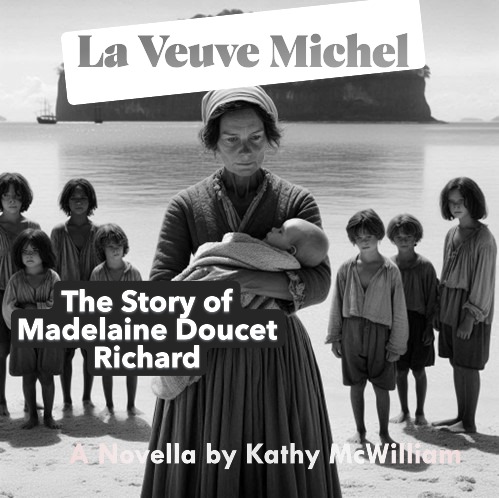
Quelques de nos voisins, they are not so well nor so happy – they have not eaten well these few years past, mon Dieu. They have not the strength to work as they must nor the fat on their bones to keep them warm. My tall strong sons help comme ils peuvent, finding old logs for them to burn, sharing game from a good hunt, bringing stew from my pot to les anciennes whose fingerbones ache too much with the cold to gut small animals, cut the beets or even stir the soup pot, mon Dieu. They stack boughs against their walls to keep out the chilling winds.
But I look at my rosy-cheeked Marguerite and little Bazile, so like their siblings and their father, merry and strong and sure and I say to Joseph, to Pierre: “Donne pas aux voisins what we need for our selves, what we will need for tomorrow, for next week, for next month. Comprends-tu?”
I see rebellion in their eyes when I say this. They make their own decisions, mes fils. Made the decisions, sûrement, that have brought us to this place, alive. Killed two soldiers who hunted us. Puis, criant à genou dans la forêt, felt the chill of anguished Jésu’s breath.
“Maman”, dis-eux, “il faut que nous donnons un part de nos bénéfices. Otherwise, will they not take, in their hunger and desperation? Better to give what we can, to help as we can and not force them to that, n’est-ce pas? Better, for the time that will come quand on doit travailler encore tous ensemble.”
Very wise, my sons. Comme Michel. Je ferme la bouche and to them leave the questions: quand, et comment, et combien. But they must know now my fears, for there are yet les enfants nos-mêmes, alors, depending on them. God forgive me, but they must not spend their strong young bodies keeping the children of others alive.
 Canadian Stories